Starting a business in Abu Dhabi does not begin on the day your licence is issued. It begins weeks earlier, with four decisions that set your cost and your timeline: the activity, the legal form, the premises, and the tax registration.
A mistake in any of them does not show up straight away. When starting a business in Abu Dhabi, it shows up later as a rejected application, a fine, or a licence you have to amend after you have already paid for it.
This guide sets out everything to do before starting a business in Abu Dhabi, step by step, in the order the application actually moves.
Why you need a plan before starting a business in Abu Dhabi
Because every step is built on the one before it.
The activity you pick determines which external approvals you need. The legal form determines your capital and your liability. The office size determines how many visas you can sponsor. Change one decision halfway through, and you are usually back at the beginning.
The good news is that Abu Dhabi is one of the easiest places in the region to set up. Economic licences are issued by the Abu Dhabi Registration and Licensing Authority (ADRA) under the Department of Economic Development, and most services run online through TAMM. New economic licences across the emirate rose 21% in Q1 2026.
1. Define the idea and test the market
The first step in starting a business in Abu Dhabi is not a government step at all. Before any application, answer three questions with numbers, not impressions:
- Who is your customer? Businesses or individuals? Abu Dhabi only, or nationwide?
- Who are you competing with? Visit them. Look at their pricing and their reviews.
- What does the business need to break even? Work out rent, salaries, annual fees and marketing for at least 12 months.
A two-page feasibility study beats nothing. It is also the first thing a bank, a partner or an investor will ask you for.
2. Choose the economic activity precisely
The activity is the heart of the licence, and it is the first technical decision in starting a business in Abu Dhabi. You choose it from the approved list of economic activities, not in your own words.
Two things to watch:
- Some activities need external approvals from bodies such as the Department of Health, Civil Defence, or the Department of Culture and Tourism. That adds time and conditions.
- A precise activity holds up better under inspection. An activity that is too broad may not cover what you actually do, and adding too many activities raises the cost and complicates approvals.
⚠️ Do not go by the name of the activity alone. Read its full description and confirm it covers what you will sell.
3. Decide: mainland or free zone?
This is one of the biggest decisions when starting a business in Abu Dhabi.
Mainland, licensed by ADRA:
- You deal directly with the local market and with government bodies.
- Most activities allow 100% foreign ownership, apart from a limited list of strategic-impact activities.
- It suits anyone targeting customers inside the UAE.
Free zones, such as ADGM, KEZAD, Masdar City, twofour54 and Abu Dhabi Airports Free Zone:
- Each has its own regime, fees and target activities.
- They usually suit international trade, holding companies, financial services and media.
- Trading directly into the local market may need extra arrangements.
Rule of thumb: if most of your customers are inside the UAE, look at the mainland option first.
4. Pick the right legal form
The legal form decides who owns the company, who carries its debts, and how profits are split. It is also one of the hardest things to reverse after starting a business in Abu Dhabi. The common options:
- Sole establishment: one owner, personally liable.
- Single-person LLC: one owner, with liability limited to the company’s capital.
- Limited liability company (LLC): two or more partners, and the most common form for mid-sized businesses.
- Branch of an existing company: for a local or foreign company expanding into Abu Dhabi.
- Freelance or home-business licence: for a small venture or a one-person professional service, at a lower cost.
If you have partners, put the shares, the authorities and the exit mechanism in writing before you sign the memorandum of association. Most partner disputes start at the point nobody wrote down.
5. Reserve the trade name
The trade name is a mandatory step in starting a business in Abu Dhabi. It is reserved through TAMM and has clear conditions:
- It must not conflict with public morals or religion.
- It must not match or closely resemble a registered name.
- It must not include the name of a government body or organisation without permission.
- It must suit the activity and the legal form.
Have at least three alternatives ready before you apply. Check that the domain and the social handles are free under the same name before you reserve it, so you do not end up licensed under a name you cannot use online.
6. Get the initial approval
This is the first formal milestone in starting a business in Abu Dhabi. Once the activity, legal form and name are settled, you apply for initial approval — the licensing authority confirming it has no objection to your activity.
Initial approval does not let you trade yet. What it does is open the next steps: leasing premises, obtaining external approvals, and notarising the memorandum of association.
7. Work out whether you need premises and a lease
Many people assume starting a business in Abu Dhabi means renting an office from day one. It does not. It depends on the licence type:
- Standard commercial licence: most activities need physical premises and a lease registered through Tawtheeq.
- Freelance (professional) licence: no lease required. It suits skilled individuals and one-person professional services.
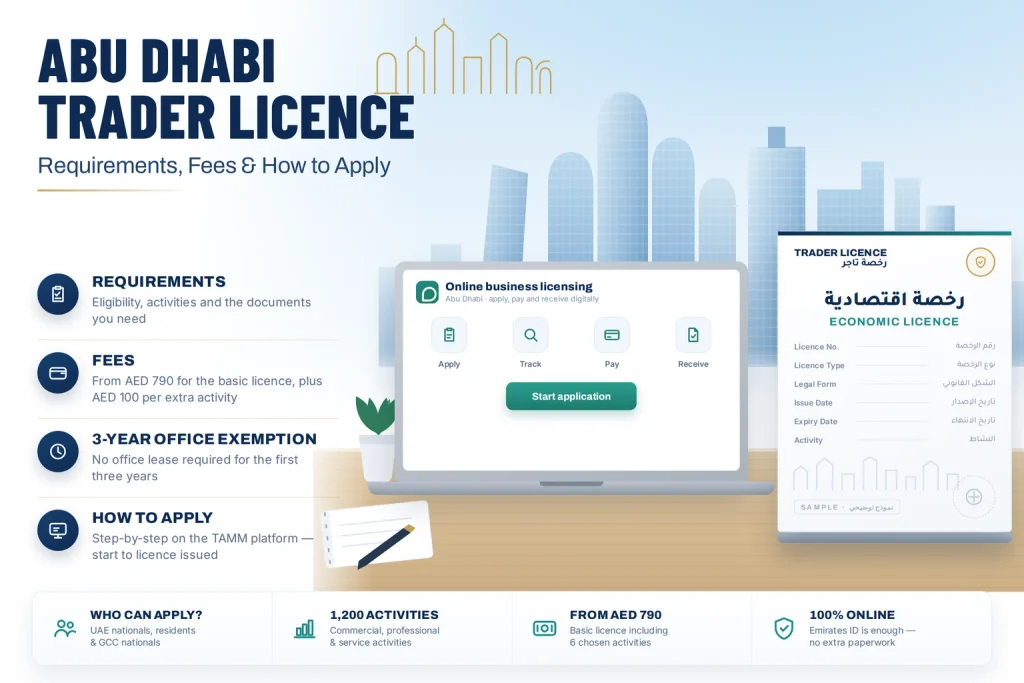
- Tajer Abu Dhabi licence: lets you trade without a lease for 3 years before you move into physical premises.
If your licence does need premises, confirm before you sign that:
- The property’s permitted use covers your activity (commercial, industrial, office).
- The space supports the headcount and visa quota you are planning for.
- The location works for customers, if they will be visiting you.
Rule of thumb: if you are testing an idea or working alone, start with a licence that does not tie you to a lease, and put that money into operations and marketing instead.
8. Plan for tax from day one
A commercial plan alone does not complete the picture. This is the step most founders skip, and then pay for in penalties.
Corporate tax:
- The rate is 9% on taxable profit above AED 375,000.
- Every new company must register with the Federal Tax Authority through EmaraTax, even if profits are below that threshold.
- A newly incorporated company normally registers within 3 months of incorporation.
- Late registration carries a penalty of AED 10,000.
VAT:
- Registration is mandatory once your taxable supplies pass AED 375,000 over 12 months.
- Registration is voluntary above AED 187,500.
Keep proper accounting records from your first invoice. Getting organised early is far cheaper than rebuilding the books later.
9. Sort out banking, visas and staff
The licence is not the end of starting a business in Abu Dhabi. Once it is issued, the operational phase starts:
- Corporate bank account: prepare the licence, the memorandum, partner IDs, ultimate beneficial owner details, and a clear description of your activity and source of funds. Banks scrutinise this closely, and an incomplete file can delay opening by weeks.
- Establishment card: with the Ministry of Human Resources and Emiratisation, and with the Federal Authority for Identity, Citizenship, Customs and Port Security, so you can issue staff visas.
- Wages Protection System (WPS): for paying salaries through approved channels.
- Ultimate beneficial owner register: a mandatory disclosure of who really owns the company.
10. Build a renewal calendar
An Abu Dhabi trade licence is renewed annually, along with the lease, the establishment cards and staff visas — and tax filings have deadlines of their own.
Put all of these dates in one calendar with a reminder at least 30 days ahead. Late renewal means fines and can freeze the company’s transactions until it is settled. Starting a business in Abu Dhabi is judged by year two, not by the day the licence is printed.
What happens if you start unprepared
These are the mistakes we see most often:
- An activity that does not match the actual work, forcing a licence amendment and extra fees later.
- Renting premises you did not need, when a freelance or Tajer Abu Dhabi licence would have covered the first stage.
- A lease on a property that does not permit your activity, so the application is rejected after the rent is paid.
- Ignoring tax registration, landing an AED 10,000 penalty on a company that has not made a profit yet.
- A verbal agreement between partners, which becomes a dispute at the first disagreement over profits.
- An incomplete bank file, delaying your first customer payment.
Every one of these is avoidable with the right decision before starting a business in Abu Dhabi.
Quick checklist before starting a business in Abu Dhabi
- ✅ A clear idea and a simple 12-month feasibility study
- ✅ A specific activity from the approved list
- ✅ A mainland or free zone decision
- ✅ A legal form and a written partners’ agreement
- ✅ Three alternative trade names
- ✅ A licence type that tells you whether premises are needed
- ✅ A plan to register for tax within the legal window
- ✅ A complete file for opening the bank account
Related guides
- Abu Dhabi trader licence: requirements and fees
- Freelance professions in Abu Dhabi
- Mobdea licence in Abu Dhabi
- Legal company liquidation in Abu Dhabi and the UAE
FAQs about starting a business in Abu Dhabi
Can a foreign national own their business outright in Abu Dhabi?
Yes. Most mainland activities allow 100% foreign ownership, apart from a limited list of strategic-impact activities. In the free zones, full ownership is the norm.
Do I need UAE residency to set up a company in Abu Dhabi?
Not necessarily. Non-residents can incorporate in many cases, but some steps — opening the bank account in particular — are far easier with a valid residence visa.
What is the difference between initial approval and the licence?
Initial approval means there is no objection to your activity and lets you complete the remaining requirements. The licence is what allows you to actually trade and contract with customers.
Can I start from home?
Yes, for some activities. A freelance licence needs no lease, and a Tajer Abu Dhabi licence lets you operate without premises for 3 years — both at a lower cost than a standard commercial licence.
Does a company register for corporate tax even with no profit?
Yes. Registration is mandatory for every taxable person regardless of profit. The tax itself is only due on profit above AED 375,000.
How long does starting a business in Abu Dhabi take?
It depends on the activity and on external approvals. Activities with no additional approvals can be completed within days through TAMM, while regulated activities can take weeks.
Can I change the activity after the licence is issued?
Yes, through a licence amendment. It may require fresh approvals and additional fees, and it can mean changing premises if they no longer suit the new activity.
Your next step in starting a business in Abu Dhabi
We handle the full file for starting a business in Abu Dhabi with you: choosing the activity and legal form, reserving the trade name, initial approval, notarising the documents, right through to the licence and establishment cards.
Send us your business idea and we will tell you the right activity and licence type, and whether you need premises at all, before you pay a single fee.
View our blog page for more articles