Company formation in Abu Dhabi involves a decision that shapes your legal structure and how you reach clients for years to come. Choosing between the mainland and a free zone such as Abu Dhabi Global Market (ADGM), Khalifa Economic Zones Abu Dhabi (KEZAD), twofour54 or Masdar City requires careful study. The mainland is the clearest choice for businesses that sell directly within the UAE and deal with government entities, while free zones suit specific activities such as financial services, manufacturing, media and clean technology. No option is best in absolute terms; the right choice depends on your revenue sources, target market and regulatory requirements.
This guide compares the two options for company formation in Abu Dhabi, explains the key differences, reviews the main free zones in Abu Dhabi and offers questions to help you find the structure that suits your project.
Table of Contents
What Are Mainland and Free Zone Companies?
A mainland company is licensed by the Abu Dhabi Department of Economic Development (ADDED) and operates under UAE federal and local laws. It may carry out its licensed activity anywhere in the UAE.
When considering company formation in Abu Dhabi, free zones are areas dedicated to specific activities, and each has its own regulations and registration authority. The main ones in Abu Dhabi are:
- Abu Dhabi Global Market (ADGM): an international financial centre with an independent legal framework based on English common law, its own courts and a financial services regulator.
- Khalifa Economic Zones Abu Dhabi (KEZAD): a large industrial and logistics zone run by KEZAD Group, close to Khalifa Port.
- twofour54: a free zone for media, production, gaming and entertainment.
- Masdar City Free Zone: a zone focused on clean energy, sustainability and green technology.
Ownership and Foreign Investment
Federal Decree-Law No. 26 of 2020 allows foreign investors to own 100% of most activities on the mainland, with exceptions for activities of strategic impact. ADDED has published a list of 1,105 commercial and industrial activities open to full foreign ownership, and the list is updated by Cabinet decisions on strategic activities. Check the official list to confirm that your activity is eligible for company formation in Abu Dhabi.
Free zones generally allow full foreign ownership for company formation in Abu Dhabi as a general rule, without a local partner requirement.
Business Activity and Access to the Local Market
This is the most practical point in most cases:
- Mainland: direct dealings with clients and government entities across the UAE, participation in tenders, and suitability for retail, services, contracting, trade and local supply.
- Free zones: generally suited to exports, foreign markets, and companies serving other businesses within the zone. Direct dealings with mainland clients from within a free zone are restricted and usually require an additional licence or a suitable legal arrangement.
If your business depends on local customers, the mainland is usually the clearest option. If it targets regional or international markets or other companies, a free zone may be more suitable.
Dual Licence
A dual licence combines the advantages of both sides of company formation in Abu Dhabi without needing an additional office outside the free zone. Examples include:
- ADGM: an agreement with ADDED allows eligible ADGM entities to serve businesses in Abu Dhabi without a physical office on the mainland. Eligibility depends on the entity type and its activity.
- KEZAD: companies registered in KEZAD can obtain an additional licence from ADDED to carry out activities outside the free zone without extra offices, according to the KEZAD Group official website.
- twofour54: companies registered with the Media Zone Authority can obtain a branch licence from ADDED under an agreement between the two parties.
Note: ADGM now includes Al Reem Island under Cabinet Resolution No. 41 of 2023, in addition to Al Maryah Island. This does not affect entities registered before the expansion.
Legal Framework and Courts
For company formation in Abu Dhabi, the mainland operates under UAE federal laws, and disputes are heard by national courts. ADGM has an independent court system applying English common law, which many international investors prefer for familiarity and contractual clarity.
KEZAD, twofour54 and Masdar City operate under federal law and the rules of each zone, and do not have an independent court system like ADGM. For the documents needed during the process, see Memorandum of Association in the UAE: Clauses, Fees and Steps.
Costs and Fees
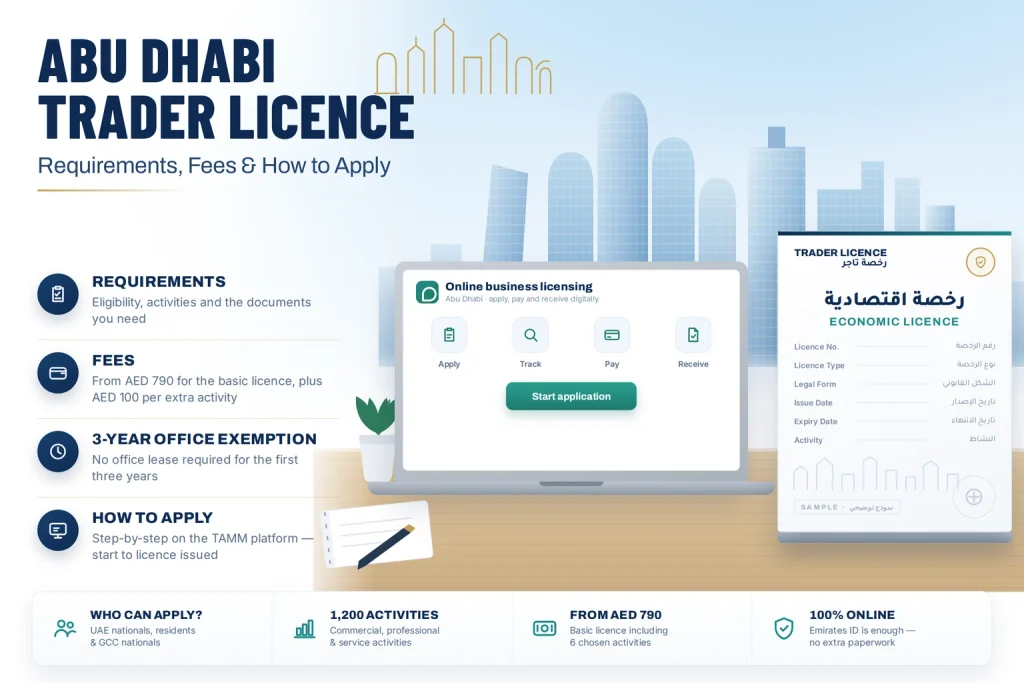
Setup and renewal costs vary by licence type, activity, number of visas and type of office. Prices for company formation in Abu Dhabi change frequently, so obtain an official quotation from the relevant authority or a licensed consultant. For a related guide, read Abu Dhabi Trader Licence: Requirements, Fees & How to Apply.
- Mainland: includes the activity licence, registration and related permits, and may require an approved lease depending on the activity.
- ADGM: includes registration, the annual licence and registered office services, and is generally higher than commercial free zones, especially for financial firms subject to additional regulatory supervision.
- KEZAD: suits industrial and logistics projects, with costs varying by need for flexible desks, warehouses or land plots.
- twofour54 and Masdar City: offer tiered packages covering the licence, workspace and a number of visas, usually lower in the early stages.
Practical tip: when planning company formation in Abu Dhabi, compare the total cost over the first three years, not the setup fees alone, including visas, office space and any additional approvals.
Corporate Tax
UAE corporate tax applies at 9% on taxable profit above AED 375,000, with 0% on profit up to that threshold. VAT at 5% applies where required.
Free zones do not automatically mean tax exemption. Under the Qualifying Free Zone Person (QFZP) regime, a company may benefit from a 0% rate only on its qualifying income, when it meets all QFZP conditions. Non-qualifying income is taxed at 9%, and a permanent establishment outside the free zone within the UAE is also taxed at 9%.
A key condition is the de minimis rule: non-qualifying income must not exceed the lower of 5% of total revenue or AED 5 million. According to tax guidance from the Federal Tax Authority, exceeding this limit causes the company to lose QFZP status for the current and the following four tax periods. Identify your revenue sources carefully before relying on the exemption, especially if a large share of your clients are on the mainland.
Abu Dhabi Free Zones at a Glance
KEZAD
Suited to manufacturing, storage, logistics, export, re-export and wholesale distribution. It allows full foreign ownership and offers office space, warehouses and land plots. A dual licence allows operations outside the free zone.
twofour54
A zone for media, production, gaming and entertainment. It offers licences for freelancers, companies and branches, and companies can obtain a licence from ADDED to work on the mainland.
Masdar City Free Zone
Suited to companies specialising in clean energy, green technology, artificial intelligence and sustainability. It offers packages with prices varying by number of activities and visas.
ADGM
Suited to financial services, asset management, funds, holding companies and fintech. It is known for English common law and independent courts.
Practical Examples
Example 1: A marketing agency serving clients in Abu Dhabi and Dubai. It relies on local clients and government entities, and needs direct market access. The mainland is usually the best choice, as it allows direct service without restrictions and opens the door to government tenders.
Example 2: A fintech company serving international investors. Its activity is financial and most clients are outside the UAE, and it needs a legal framework that reassures investors. ADGM is usually the most suitable, with a dual licence if it later needs to serve local clients.
Example 3: A media production company. It produces content for local and international clients and needs a studio and workspace. twofour54 is usually the most suitable, with an ADDED licence if it works with entities on the mainland on a regular basis.
If you plan to bid for federal or ADNOC tenders, an ICV certificate matters too: bidders without one are scored at zero on in-country value.
How to Choose the Right Structure
Ask yourself these questions before deciding on company formation in Abu Dhabi:
- Who are your clients? Individuals, local companies or government entities point to the mainland. International companies or investors point to free zones.
- What is the nature of your activity? Financial services suit ADGM, industry and storage suit KEZAD, media suits twofour54, clean energy suits Masdar City, and trade and local services suit the mainland.
- Do you need to deal with the mainland? If this is an important part of your activity, consider a dual licence or the mainland directly.
- What is your expansion plan? Will you open local branches, or expand regionally or internationally?
- What is your budget for the first three years? Calculate the full cost, not only the setup fees.
- What are your revenue sources? This determines whether the company can keep the 0% rate in a free zone.
Once you have chosen the structure, follow the step-by-step checklist in our guide to starting a business in Abu Dhabi: activity, trade name, initial approval, premises, tax registration and the bank account.
Conclusion
For company formation in Abu Dhabi, if your main market is customers inside the UAE, the mainland is the most direct and practical option. If your activity is industrial, media, technology or financial, one of Abu Dhabi free zones may suit you, provided its tax and regulatory conditions are met. In many cases the best solution is a combination: a free zone structure with a licence for the mainland.
Before setting up, review the current requirements and fees with ADDED, the ADGM authority and the free zone you choose, as rules change. Consult a licensed legal or tax adviser to find the best option for your situation. This article is for general guidance and is not a substitute for legal or tax advice.
Frequently Asked Questions
Can a company registered in ADGM serve clients in Abu Dhabi directly?
Yes, for some categories through a dual licence, without a physical office on the mainland, subject to specific conditions that must be verified.
Does every company need a physical office?
It depends on the activity and licence type chosen for company formation in Abu Dhabi. Some licences require a physical address, while others allow flexible desks.
Does a free zone mean full tax exemption?
No. The exemption applies only to qualifying income of a company that meets the QFZP conditions. Non-qualifying income is taxed at 9%.
Can the legal structure be changed later?
Yes, usually through restructuring, transferring the activity or setting up a new entity. This requires procedures and costs, so it is better to choose correctly from the start.
Official References
- Abu Dhabi Department of Economic Development (ADDED)
- Abu Dhabi Global Market (ADGM)
- Federal Tax Authority
- KEZAD Group
- twofour54
- Ministerial Decision No. 139 of 2023 (Ministry of Finance)
Disclaimer: This article is for general guidance only and is not legal or tax advice. Verify all information, figures and conditions with the relevant official authorities before relying on them or making any decision.